Passage 1
The painter’s late works defied the conventions that had once elevated him. His brush, once precise and reverent, now moved with the urgency of someone wrestling against time itself. To critics, these pieces seemed chaotic, even careless; yet to the few who saw beyond the disorder, each stroke revealed a deeper defiance—a refusal to immortalize serenity when turmoil was more truthful.
Q1: The author’s central idea most strongly suggests that the painter’s later style was motivated primarily by which of the following?
The phrase “defied conventions” and “refusal to immortalize serenity when turmoil was more truthful” show conscious rebellion, not decline or nostalgia.
Passage 2
Many historians have treated the Industrial Revolution as an unambiguous triumph of human ingenuity. Yet such a view ignores the profound social dislocations that accompanied it—the displacement of craftsmen, the rise of child labor, and the choking of cities beneath their own prosperity. Progress, in this light, seems less a victory than a bargain struck at an incalculable cost.
Q2: What is the author’s most likely purpose in describing the Industrial Revolution as “a bargain struck at an incalculable cost”?
Passage 3
Quantum theory unsettled not only physics but philosophy. In suggesting that particles could exist in states of probability rather than certainty, it challenged the Newtonian conviction that the universe was an intricate but predictable machine. For scientists of the early twentieth century, this realization was less an intellectual triumph than an existential shock.
Q3: The author’s tone toward the scientists of the early twentieth century is best described as
Passage 4
The philosopher’s argument was less a defense of optimism than a critique of despair. He did not claim the world was inherently good; rather, he maintained that resignation was intellectually lazy—a refusal to engage with the world’s contradictions. Hope, to him, was not naïveté but a moral discipline.
Q4: In context, the phrase “a moral discipline” most nearly means —
Passage 5
Although digital communication promised connection, it has paradoxically intensified loneliness. Users curate versions of themselves designed to invite admiration, not intimacy. In such spaces, conversation becomes performance, and silence—once a sign of reflection—feels like exile.
Q5: Which statement best captures the author’s implicit criticism of digital culture?
Passage 6
Coral reefs, often called the rainforests of the sea, are vanishing at an alarming rate. Their disappearance is not merely an environmental tragedy but an economic one: millions depend on them for food and livelihood. To ignore their decline, therefore, is not only shortsighted but self-destructive.
Q6: The reasoning in the passage relies on which underlying assumption?
Passage 7
The protagonist’s journey through the desert mirrors his internal search for meaning. Each mirage he chases dissolves into emptiness, yet the act of pursuit gives his existence coherence. In a landscape stripped of illusion, the mirage itself becomes his only truth.
Q7: What function does the desert imagery primarily serve in the passage?
Passage 8
Letters from soldiers in the First World War rarely express hatred for the enemy. Instead, they dwell on exhaustion, comradeship, and the bewilderment of being caught in machinery beyond their understanding. Such testimony complicates the romantic notion of war as a matter of heroism.
Q8: What claim about historical evidence does the passage most strongly support?
Passage 9
The discovery of exoplanets has transformed astronomy, revealing worlds both familiar and strange. Yet our instruments can only infer their existence through shadows and flickers of light. In studying these faint signatures, scientists confront an irony: the more they learn, the more distant these worlds remain.
Q9: The irony described in the passage is that —
Passage 10
To say that freedom is the absence of restraint is to mistake chaos for choice. True freedom, the philosopher insists, lies not in doing as one pleases but in knowing what one ought to do. Discipline, therefore, is not its enemy but its condition.
Q10: What relationship between ideas structures the passage?
Passage 11
Museums once displayed artifacts as trophies of empire, evidence of conquest disguised as curiosity. Today, they are compelled to confront those origins, to decide whether preservation can coexist with restitution. The past, it seems, demands not admiration but accountability.
Q11: What attitude toward modern museums is most clearly conveyed?
Passage 12
Economists often speak of “rational choice,” as though decisions were made in laboratories rather than in lives. But people weigh not only profits and losses; they weigh pride, memory, and fear. To reduce humanity to calculation is to misunderstand both reason and emotion.
Q12: How does the author develop the central idea?
Passage 13
Some environmentalists argue that small individual actions—recycling, reducing plastic—are trivial compared to systemic change. Yet collective habits, repeated by millions, shape demand and therefore policy. To dismiss them is to misunderstand how culture and politics intertwine.
Q13: What reasoning strategy does the author employ to defend individual action?
Passage 14
The fall of empires is rarely sudden. It begins in the corrosion of trust—citizens doubting institutions, leaders mistaking spectacle for strength. By the time the collapse arrives, it feels less like a storm than a long-delayed recognition.
Q14: What rhetorical technique does the author use to convey inevitability?
Passage 15
She wrote letters she never sent, rehearsing conversations that would never occur. For her, writing was not communication but containment—a way to hold chaos still long enough to name it. In the silence between her words, the truth trembled.
Q15: What is the passage’s central theme?
Passage 16
To act morally is not to obey rules but to perceive rightly. Rules can only describe conduct; perception apprehends value. A virtuous person, then, does not consult commandments before acting—he sees what is fitting as immediately as the eye sees color. Ethics, in this sense, is not learned but cultivated.
Q16: The passage suggests that moral understanding is achieved primarily through —
Passage 17
The Enlightenment’s faith in reason was not the rejection of tradition it appeared to be; rather, it was a new tradition of its own—one that sanctified inquiry and enthroned skepticism. In liberating humanity from dogma, it merely replaced one form of certainty with another.
Q17: The author most likely views the Enlightenment as —
Passage 18
The poet’s solitude was not isolation but a chosen discipline. He withdrew not to escape the world but to perceive it more precisely, as though distance could clarify what proximity obscured. To the inattentive, he seemed detached; to himself, he was finally awake.
Q18: What does the passage suggest about the poet’s relationship to solitude?
Passage 19
Climate models are often criticized for their uncertainty, yet uncertainty is not ignorance—it is the measure of what is known. To quantify doubt is to understand the limits of prediction. The precision of a forecast, paradoxically, lies in its honesty about imprecision.
Q19: What is the central paradox of the passage?
Passage 20
Revolutions are often narrated as explosions of freedom, yet their aftermath reveals a subtler truth: power rarely disappears; it merely changes costume. Those who once overthrew authority soon learn to wield it. The rhetoric of liberation, history suggests, is often rehearsal for domination.
Q20: The author’s argument rests on which implicit assumption?
Passage 21
The biographer’s task is both impossible and necessary. To capture a life in language is to betray it, yet silence betrays it more completely. Between fact and empathy, the writer must choose neither, weaving instead a fiction that tells the truth.
Q21: The phrase “a fiction that tells the truth” conveys what paradox about biography?
Passage 22
Democracy depends not only on votes but on the capacity for disagreement. When citizens fear to differ, consensus ceases to be harmony and becomes coercion. The true measure of freedom is not unanimity, but the space allowed for dissent.
Q22: Which statement best expresses the passage’s central claim?
Passage 23
Artificial intelligence does not “think” as humans do; it recognizes patterns without understanding them. Its brilliance is statistical, not conceptual. To call it intelligent is less a statement about machines than about our willingness to mistake prediction for comprehension.
Q23: What does the author imply about human attitudes toward AI?
Passage 24
The river in the novel flows not toward freedom but toward forgetting. Each bend erases what the last revealed, carrying the characters farther from themselves. In its restless motion, they mistake movement for progress, never seeing that they drift in circles.
Q24: The river most likely symbolizes —
Passage 25
Modern identity is less a fixed essence than a performance repeated until it appears natural. The self, once imagined as an inner truth, is now seen as a script rehearsed under social gaze. Authenticity, paradoxically, depends on how convincingly one enacts the role of being oneself.
Q25: Which idea best captures the paradox described in the passage?
Passage 25
When the observatory first released images from its new telescope, the world marveled at the beauty of distant galaxies. Yet to the scientists who built it, the images were more than aesthetic wonders—they were proof that decades of theoretical models were correct. Ironically, what the public celebrated for its artistry was, to the astronomers, a mathematical victory: the triumph of equations that had predicted unseen cosmic structures.
Q26: What is the central idea of the passage?
Passage27:
During the Industrial Revolution, time ceased to be measured by the rising and setting sun and began to obey the ticking of the factory clock. This transformation reshaped not only labor but consciousness itself; punctuality became moral virtue, and idleness, sin. The mechanical regularity that drove engines also began to govern human lives, binding society to a rhythm that was once foreign to the natural world.
Q27: Which statement best captures the author’s perspective?
Passage 28
Sociologists once believed that urbanization inevitably led to the decay of community, but recent research paints a subtler picture. In crowded cities, social bonds often adapt rather than vanish—neighbors form micro-networks based on shared needs, not kinship. Paradoxically, anonymity can foster tolerance: when everyone is a stranger, differences lose their threat. The challenge, however, lies in balancing privacy with participation. Cities thrive when solitude and connection coexist, neither overwhelming the other.
Q28: The author challenges a traditional sociological assumption by arguing that urban life, rather than destroying community, transforms it. How does this transformation alter the meaning of social cohesion in modern cities? Consider both the paradox of anonymity and the redefinition of belonging implied by the text.
Passage 29
Historians often frame the Enlightenment as an age of pure reason, yet its most radical thinkers were driven by moral urgency, not detached analysis. They believed rationality must serve justice, that logic divorced from empathy produces tyranny disguised as order. The era’s contradictions—championing liberty while tolerating slavery—reveal the fragility of progress when intellect outruns conscience.
Q29: The author presents the Enlightenment as a complex era in which rational ideals both advanced and undermined humanity. How does this portrayal revise the common view of the period, and what warning does it offer about the relationship between intellect and morality?
Passage 30
The rise of artificial intelligence has reignited an ancient debate: what separates human judgment from mechanical precision? A machine can analyze patterns faster than any mind, yet it cannot value one outcome over another without human instruction. The passage suggests that intelligence divorced from meaning is incomplete—a calculator without conscience, a mirror reflecting everything but understanding nothing.
Q30: In exploring the contrast between human and artificial reasoning, the author implies a deeper question about the nature of understanding itself. How does the passage define the boundary between computation and comprehension?
Passage 31
The biologist observed that evolution favors not strength but adaptability. Species that survive are those that adjust fastest, not those that dominate longest. This principle, she argued, applies equally to ideas and institutions: intellectual ecosystems perish when they resist change. The vitality of a culture, then, depends on its capacity to evolve without abandoning its roots—a balance as delicate as life itself.
Q31: Drawing from the biological metaphor, the passage suggests that cultural endurance depends on flexibility rather than rigidity. What broader insight does the author offer about the relationship between tradition and innovation?
Passage 32
The astronomer mused that starlight’s journey across millennia reveals a paradox of perception: we see the past as present. Each gleam in the night sky is an echo, a message delayed by distance. To study the cosmos is to confront time’s vast elasticity—a universe in which the act of observation is always a form of remembrance. Knowledge, the passage implies, is never immediate; it is light arriving late.
Q32: The author uses astronomical imagery to explore how time alters the nature of knowledge. What philosophical insight does this analogy convey about human understanding and perception?
Passage 33
Political theorists often claim that democracy depends on the will of the people, yet the author argues that it relies even more on the patience of its citizens. The freedom to disagree demands the discipline to listen; otherwise, liberty collapses into noise. True participation, therefore, is not the loudest shout but the quiet endurance of argument—an act of faith that dialogue itself can outlast division.
Q33: The author redefines democratic strength not as the number of voices but the endurance of conversation. What does this imply about the nature of civic freedom and its preservation in modern societies?
Passage 34
In examining scientific revolutions, the historian noted that discovery is often born not from certainty but from productive confusion. When old frameworks collapse, imagination enters. The scientist who admits “I don’t know” stands closer to truth than one who insists on final answers. Knowledge advances, paradoxically, through doubt that refuses to despair.
Q34: The passage portrays uncertainty as an engine of discovery rather than an obstacle. How does this perspective challenge conventional ideas about knowledge and intellectual authority?
Passage 35
The novelist observed that memory is less a record than a reconstruction. We do not replay the past—we rewrite it with each recollection, filtering fact through feeling. What we call “truth” is therefore a collaboration between event and interpretation. Forgetting, she implied, may sometimes preserve honesty better than remembering inaccurately.
Q35: According to the passage, how does the author redefine the function of memory in shaping personal truth?
Passage 36
The economist proposed that wealth should be measured not by accumulation but by circulation. Prosperity arises when value moves—through trade, invention, generosity. Hoarded riches, like stagnant water, breed decay. The moral, implicit yet clear, is that economies, like hearts, thrive by giving, not withholding.
Q36: The passage challenges traditional measures of economic success. How does the metaphor of circulation redefine the ethical dimension of prosperity?
Passage 37
The philosopher observed that technology extends human capability but also amplifies human error. Every tool, from the wheel to the algorithm, magnifies intention—good or ill. Progress, therefore, is not measured by innovation alone but by the wisdom guiding its use. The danger lies not in machines, but in the motives of their makers.
Q37: By examining the dual nature of technological progress, the author highlights a moral tension between invention and intention. What principle does this perspective emphasize regarding the ethical use of innovation?
Passage 38
The philosopher argued that modern education prizes information over wisdom, mistaking the storage of facts for the cultivation of thought. Students, she observed, emerge fluent in data but mute in judgment. In a world where knowledge can be retrieved instantly, discernment—not recall—becomes the true mark of intellect. Yet, institutions persist in measuring intelligence by quantity, not quality, rewarding memorization while neglecting meaning. The paradox is cruel: the more we know, the less we understand why it matters.
Q38: The author critiques contemporary education for confusing the acquisition of knowledge with the development of wisdom. How does this distinction redefine the goal of learning in the information age?
Passage 39
The historian reflected that revolutions rarely fail because of oppression, but because of impatience. Freedom, she claimed, requires time—the slow construction of institutions that can hold its weight. When liberation rushes ahead of order, chaos fills the vacuum. Yet, societies intoxicated by the promise of instant justice often mistake velocity for progress. History’s tragedy is not that people fight for freedom, but that they demand it to arrive overnight.
Q39: The passage warns that the pursuit of rapid change can undermine the very liberty it seeks. What broader principle about political transformation does the author convey?
Passage 40
The literary critic observed that irony, once a weapon of intellect, has become a shield against sincerity. In cultures saturated with sarcasm, vulnerability is treated as weakness, and the courage to mean what one says feels almost radical. Yet authenticity, the passage insists, is not naïveté—it is the rare strength to risk being earnest in an age of detachment. The critic laments that irony, once liberating, now imprisons us in perpetual distance from ourselves.
Q40: According to the author, what does the cultural dominance of irony reveal about modern attitudes toward sincerity and emotional expression?
Passage 41
The environmentalist warned that climate policy often mistakes measurement for action. Nations celebrate carbon accounting while ignoring the deeper challenge—transforming values of consumption and growth. Numbers soothe conscience but seldom change behavior. True sustainability, she argued, begins when societies redefine prosperity not by production, but by balance. The planet does not need efficient exploitation; it needs restraint guided by wisdom.
Q41: The passage contrasts symbolic gestures of environmental progress with substantive change. What key insight does the author offer about humanity’s moral relationship to sustainability?
Passage 42
The neuroscientist noted that consciousness may be less an on/off state than a spectrum—a fluid negotiation between perception and attention. Dreams, creativity, and memory blur its boundaries. Perhaps, she mused, the mind is not a mirror but a storyteller, assembling meaning from fragments. To study consciousness, then, is to study interpretation itself: the brain’s art of transforming chaos into coherence.
Q42: By portraying consciousness as interpretive rather than mechanical, the author reshapes our understanding of the human mind. What does this view suggest about the nature of perception and reality?
Passage 43
The sociologist observed that modern loneliness is not the absence of people, but of purpose. Surrounded by communication, individuals still feel unseen because connection without meaning is emptiness disguised as activity. The passage contends that true community arises when shared goals replace mere contact. In the digital age, belonging must be built on contribution, not visibility.
Q43: The passage redefines loneliness in the context of constant connectivity. What broader commentary does it make about the quality of modern social interaction?
Passage 44
The moral philosopher argued that forgiveness is not the erasure of wrongdoing but the refusal to let harm dictate the future. To forgive is not to forget, but to reclaim moral agency from resentment. Justice demands memory; mercy demands release. The tension between them defines humanity’s struggle to heal without denial, to remember without vengeance.
Q44: In defining forgiveness as an act of moral strength, the author explores the complex balance between justice and mercy. What ethical insight does this perspective reveal?
Passage 45
The political scientist wrote that global cooperation fails not from scarcity but from mistrust. Nations, she argued, act as though goodwill is a finite resource, hoarding it behind borders. Yet, in crises—from pandemics to climate threats—mutual survival depends on shared vulnerability. The paradox is that power grows only when it is distributed; strength isolated becomes fragility in disguise.
Q45: The passage uses the metaphor of scarcity to expose flaws in global politics. What fundamental principle does it advance regarding international collaboration?
Passage 46
The art historian observed that great architecture is not frozen music, as the poet claimed, but disciplined empathy—matter arranged to move the soul. Buildings endure because they speak to human rhythm, balancing proportion with presence. In every arch or column lies an argument about harmony: beauty as order that breathes.
Q46: The passage presents architecture as an emotional and intellectual dialogue between form and feeling. What broader idea about art does this convey?
Passage 47
The ethicist warned that technology tempts humanity with the illusion of control. Algorithms promise mastery over chaos, yet every simplification hides complexity. Predictive systems cannot foresee conscience; data cannot calculate compassion. Progress, she concluded, must be guided not by what we can do, but by what we should do.
Q47: The passage contrasts technical capacity with moral responsibility. What essential warning does the author offer about the pursuit of technological power?
Passage 48
The economist argued that markets, though praised for efficiency, rarely account for moral value. A forest’s worth, she noted, is tallied in timber, not tranquility; a child’s potential, in productivity, not possibility. By converting all things into price, society mistakes calculation for comprehension. True prosperity, she proposed, lies not in what can be bought, but in what should never be sold.
Q48: The passage challenges the assumption that markets can measure all forms of value. What fundamental criticism does the author make of economic reasoning?
Passage 49
The biologist observed that evolution favors not the strongest, but the most adaptable. Yet humanity, armed with intelligence, often resists adaptation—insisting the environment must conform to its desires. Climate change, she warned, is nature’s reminder that dominance without flexibility is extinction disguised as progress. Survival belongs not to control, but to cooperation with change.
Q49: How does the author redefine the concept of survival in the context of human progress?
Passage 50
The psychologist wrote that memory is less a recording than a reconstruction. Every recollection, shaped by current emotion, is both true and untrue. What we call “the past” is a living narrative, rewritten by each retelling. The danger, she warned, is not forgetting—but believing our edited versions are complete.
Q50: What does the passage imply about the reliability of human memory?
Passage 51
The philosopher claimed that freedom without responsibility is not liberty but license. When individuals assert rights without regard for others, autonomy becomes anarchy. True freedom, he insisted, exists only within moral boundaries—rules chosen not by coercion but by conscience. The paradox of liberty is that it survives only through self-restraint.
Q51: What paradox about freedom does the author explore in the passage?
Passage 52
The historian reflected that every empire falls not when enemies grow stronger, but when imagination grows weak. Power erodes when vision narrows to preservation instead of progress. Civilizations collapse, she argued, when their future becomes merely an echo of their past. Renewal demands courage to dream again.
Q52: What central idea about the decline of civilizations does the author convey?
Passage 53
The linguist noted that language shapes not only what we say, but what we can think. A culture’s vocabulary determines its horizon of awareness; words are the architecture of perception. To change how people see, she argued, one must first change what they can name. Silence begins not when speech ends, but when meaning lacks the words to exist.
Q53: What relationship between language and thought does the author propose?
Passage 54
The ethicist observed that modern virtue often disguises itself as visibility. Acts of generosity, once private, are now public performances measured by applause. In a culture of constant exhibition, morality risks becoming marketing. The challenge, she wrote, is to do good when no one is watching—to measure worth not in likes, but in silence.
Q54: According to the passage, what danger arises when moral action becomes public display?
Mathematics - No calculator
This section includes questions that assess a range of mathematical skills. The use of a calculator is permitted. You may use the provided reference sheet, calculator, and these directions during the test.
Unless otherwise stated:
-
All variables and expressions represent real numbers.
-
All figures are drawn to scale.
-
All figures lie in a plane.
-
The domain of any given function f is the set of all real numbers x for which f(x) is a real number.
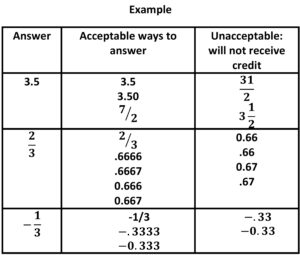
For multiple-choice questions, solve each problem and enter your answer as directed below:
-
If you find more than one correct answer, enter only one.
-
You may enter up to 5 characters for a positive answer and up to 6 characters (including the negative sign) for a negative answer.
-
If your answer is a fraction that does not fit in the provided space, enter its decimal equivalent.
-
If your decimal answer exceeds the available space, truncate or round it to the fourth digit.
-
If your answer is a mixed number (e.g., 3 ½), enter it as an improper fraction (7/2) or its decimal equivalent (3.5).
Q55. If \( 3x-5=16\), what is \( x \)?
Q56. If \( 2(4-y)=10 \) , what is \( y \)?
Q57. If \( x^2 - 6x + 8 = 0, \) which of the choices is a solution for \( x \)?
Q58. A rectangle has perimeter 30 and width 5. What is its length?
Q59. If \(\frac{2}{3}k = 8\), what is \(k\)?
Q60. Simplify: \( 5^2 - 3 \cdot 4.\)
Q61. If \( f(x)=2x+1 \), what is \(f(3)? \)
Q62. A line passes through \( (0,2) \) and \( (2,6) \). What is its slope?
Q63. If \( 3^x = 27 \), then \(x=\) ?
Q64. If the average of four numbers is 10 and three of them are 8, 9, and 11, what is the fourth number?
Q65. Solve for \( x: \frac{x}{4} + 3 = 7\).
Q66. If \(x\) and \(y\) are integers and \(x−y=5\), which of these could be the pair \((x,y)\)?
Q67. If \(2x+3y=12 \) and \( x-y=1\), what is \( x \)?
Q68. A quadratic with leading coefficient 1 has roots \(2\) and \(-3\). Which quadratic matches that?
Q69. If \( g(x)=x^2-4x+7 \), what is the minimum value of \( g(x) \)?
Q70. A circle has diameter \(10\). What is its area? (Express with \( \pi.)\)
Q71. If \( \log_{10} x = 3\), then \(x= ? \)
Q72. If a triangle has sides \( 7, 24,\) and \(25\), what type of triangle is it?
Q73. Solve for \( x: \frac{1}{x}+\frac{1}{x+2}=\dfrac{3}{4}\). Which of the choices is a solution?
Q74. A box contains \(red : blue : green\) balls in ratio \(2:3:5\). If there are 40 balls total, how many are green?
Q75. If \( y=3x^2-6x+4\), by how much does \(y\) change when \(x\) increases from \(1\)to \(2\)?
Q76. If a line has equation \(y=mx+2\) and is perpendicular to \(y=\frac{1}{2}x-3\), what is \(m\)?
Q77. The function \( h(x)=\sqrt{4x+12}\). What is its domain?
Q78. If 5 is 20% of a number, what is the number?
Q79. A segment from \((1,2)\) to \( (5,6)\) is dilated from the origin by factor 2. The image of \( (5,6)\) is:
Q80. Solve \( 2^{x}=8\). Then \(x=?\)
Q81. The probability of event \(A\) is \( \frac{2}{5}\). The complement probability is:
Q82. If \( f(x)=ax^2+bx+c \) and \(f(1)=4\), \(f(2)=9\) , \(f(3)=16 \), what is \( f(0) \)?
Q83. An arithmetic sequence has first term \(4\) and common difference \(3\). What is the \(10th\) term?
Q84. The midpoint of the segment with endpoints \((2,-1)\) and \((8,3)\) is:
Q85. If \(y=\frac{2}{x}\), what is the slope of the tangent at \( x=2? \) (Differentiate.)
Q86. A line passes through \( (0,0) \) and \( (3,4)\). The equation is:
Q87. If the area of a square is \(49\), its diagonal length is:
Q88. Solve \( |2x-3|=7 \).
Q89. A line has y-intercept \( 3\) and x-intercept \(6\). Its equation is:
Q90. If the mean of the set \( \{2,5,7,x\} \) is 6, what is \(x?\)
Q91. The graph of \( y=x^2-2x\) is shifted right by 3 units. What is the new equation?
Q92. If a fair die is rolled twice, probability both rolls are even is:
Q93. A \(20\% \) increase followed by a \( 20\% \) decrease produces an overall change of:
Q94. If \( x^2-5x+6=0 \), what are the values of \(x\) ?
Q95. The lines \( y=2x+1 \)and \(y=−x+7 \) intersect at what point?
Q96. If \( f(x)=ax+b \) and \( f(1)=4\) , \(f(3)=10\), what are \(a\) and \(b\)?
Q97. If the exterior angle of a regular polygon is \( 15^\circ\), how many sides does it have?
Q98. The sum of interior angles of an n-sided polygon is \( 1260^\circ \). What is n?